Say Goodbye to Prompts – a guest post by Sarah MacLaughlin

July 9, 2012

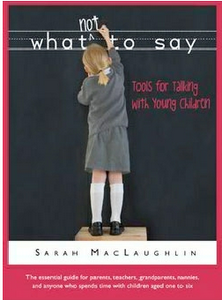
Excerpted and adapted from the award-winning Amazon bestselling book, What Not to Say: Tools for Talking with Young Children.

Letting go of prompts is a serious commitment. Offering children cues is a verbal habit that is hard to break. But overuse of prompting usurps kids’ personal power. And it becomes exhausting for the adult too!

Here are three classic prompts that you can avoid with a little practice. I’ve also included Reading Tips because reading books with children that promote courteous behavior and respect for others is an effective way to send these messages without nagging.

What’s the magic word?

Most adults want children to have good manners. We certainly don’t remind and nag at a baby to start crawling, and it isn’t productive for learning other behaviors like manners. Ironically, asking repeatedly for please or thank you can cause a child to overlook these graces. Why should she remember to say the magic words if you always jog her memory?

I have effectively taught children to use polite phrases by simply always using them myself. In social situations where you would feel rude if a child didn’t say the right thing, speak for your child (he will hear you) without sarcasm or a mocking tone: “Thanks, Aunt Trudy. Frankie will love playing with this truck.”

Reading Tip:

Rude Giants by Audrey Wood. Ages two and up. These unruly giants get some etiquette help.

You have to share.

During their first five years, kids struggle with sharing sometimes. (If not most times!) Children near age two have particular difficulty with sharing. (Have you read The Toddlers Creed?) This is normal and to be expected.

You might have heard a child scream “No! Mine!” at the top of her lungs if another child makes even a slight move toward a toy or cookie she is holding. Experts claim that at the peak of the “mine” stage, a toddler’s perception of a toy she possesses is that it is an actual part of her. When someone takes away that toy, she feels the same as if an arm or leg has been taken. This certainly explains all that wailing, doesn’t it?

Reading Tips:

The Pigeon Finds a Hot Dog! by Mo Willems. Ages six months and up. A pigeon wants to eat the hot dog himself but decides to share in the end.

Sheila Rae’s Peppermint Stick by Kevin Henkes. Ages one and up. Sheila Rae doesn’t want to share at first, but then something happens that changes her mind.

Go say you’re sorry.

Forcing a child to apologize is usually frustrating for someone—the child who has been given no choice in the matter, or the adult if the child refuses (Most likely, both.) I’ve seen moms and dads have major “say you’re sorry” showdowns with children who have just begun to speak: “We will stand right here until you say you are sorry for hitting your friend!” It is upsetting to watch one child hurt another, but trying to save face in this situation is a trap.

Children under five are still developing empathy and don’t benefit from a forced apology. The best response is to describe what occurred. It helps the child understand the connection between cause and effect—you did this, and it caused that. A great example for toddlers is for an adult to handle the wrongdoing and apologize to the affronted child or grown-up: “I’m sorry Helen pushed you and took that toy. Are you okay?” At a later stage in development (around age three-and-a-half), ask the child to check in with the friend she has offended or injured. This works like a scaffold to help the apology be included, which it usually will if it has been demonstrated often enough.

Reading Tips:

I’m Sorry by Sam McBratney. Ages one and up. Two young friends want to play together, but first they must mend hurt feelings.

How to Lose All Your Friends by Nancy Carlson. Ages two and up. This “how to” tells you exactly what not to do if you want friends.

A realization that might help you give up prompting entirely is that kids are wise and capable and they will figure it out. Sometimes it takes a few reminders to trust our children, to remember that they are inherently good and smart. We are all capable of both “good” and bad” behavior—read here about the internal battle we all have involving two wolves. In my line of work it is often said that you grow what you measure. Let’s assume the best and measure the good stuff.

Special Giveaway!

Please comment on this post about prompts you notice. Your comment enters you in the eBook Giveaway — to win an ebook copy of What Not to Say: Tools for Talking with Young Children, in the format of your choice: PDF, epub, or Kindle format. Sarah will be giving away one copy at each blog stop and will announce it on the comments of this post tomorrow. Be sure to leave your email so we can contact you in case you’re the winner!

Other stops and opportunities to win during this Blog Tour are listed on Sarah’s blog.

Also, you can enter at Sarah’s site for the Grand Prize Giveaway: a Kindle Touch. Winner will be announced at the end of the tour after July 15th. Click here to enter.

About The Author

Sarah MacLaughlin has worked with children and families for over twenty years. With a background in early childhood education, she has previously been both a preschool teacher and nanny. Sarah is currently a licensed social worker at The Opportunity Alliance in South Portland, Maine, and works as the resource coordinator in therapeutic foster care. She serves on the board of Birth Roots, and writes the “Parenting Toolbox” column for a local parenting newspaper, Parent & Family. Sarah teaches classes and workshops locally, and consults with families everywhere. She considers it her life’s work to to promote happy, well-adjusted people in the future by increasing awareness of how children are spoken to today. She is mom to a young son who gives her plenty of opportunities to take her own advice about What Not to Say. More information about Sarah and her work can be found at her site and her blog.


Triggers

July 1, 2012

Crying over spilt milk? A broken stick? The fact that you cut the toast straight across instead of diagonally? Something that seems to you utterly ridiculous and unimportant?

Possibly. Probably not. Probably really crying about something else, more important, bigger, deeper. The spilt milk was just a trigger.

My child sometimes appears to get upset about something small, seemingly petty, then get really upset, disproportionately upset. Then I know there’s probably something bigger that’s bothering him. It might have been bothering him for some time. Maybe he couldn’t articulate it, maybe he thought he was OK about it. It’s probably been bubbling away under the surface for some time. The broken stick, or the ball not rolling in the right direction was just the final straw, the trigger. Then, once allowing those pent-up emotions to come out it’s a bit like a volcano that’s been waiting to erupt.

Adults do it too. Can you remember ever having a complete meltdown just because you dropped something?  That final thing that just tipped you over the edge? But you probably realised it wasn’t just the dropping something that you were crying about.

My child doesn’t always seem to realise this. So if I say, “I don’t think you’re really crying just about the stick” he becomes more upset and angry. “I am! I really wanted to play with that stick!” But sometimes, if I know what’s bothering him, it can help. It’s just a matter of feeling my way. “I wonder if you’re feeling sad that Granny & Grandad are leaving today”. If I’m right this can allow my child to admit and recognise these feelings, and then of course cry even more. But if I don’t know what’s bothering him, that’s OK too. Maybe he’s just tired and hungry after all. There’s not always really a need to say anything at all. He just needs me to be there for him,  and allow him to have a good cry so he can heal and move on.

My biggest temptation is usually to try to fix things, to say things that will make him feel better. “Never mind, we’ll see Granny and Grandad again soon”. But this isn’t what he needs, it isn’t helpful. He just needs me to validate his feelings and let him know they’re OK.  Another pitfall is to try to distract, cheer up, or worse, belittle or dismiss his feelings, not recognising that there’s more to it than just a broken stick.  Distractions may work in the short-term (although the older he gets the less likely this is), but it’s really just a delay tactic, and doesn’t allow him the time to fully deal with his feelings. It’s like putting a lid on a bubbling saucepan. If there’s something bubbling away under the surface it has to overflow eventually. Better to get it all out at once, in one big storm, than have a day of puzzling, difficult, disconnected behaviour.

Finally, I never send him away to cry, or threaten or bribe him to stop crying. The crying is annoying, but too often it gets treated as bad behaviour. When we threaten children into silence we are telling them that we don’t accept their feelings, and teach them to suppress them. When we ignore them we are telling them we don’t care.  This is not what they want to hear, and probably not really what we want to say.

Yes, I want him to stop crying, but the quickest way is always to allow things to run their course. When he’s finished he’s refreshed, and we’re connected, and both ready to move on. Happily.


Cherie Blair’s mythical yummy mummies

June 22, 2012

What to make of Cherie Blair’s recent remarks? Just another strike in the ‘mummy wars’ – stay at home mum versus working mum? Probably. But what stood out for me as being particularly idiotic was her reference to ‘yummy mummies’.

I’ve always been puzzled by that expression. What does it mean exactly? A recent thread in the Guardian asked this question and got varied answers ranging from women who manage to retain their sex appeal after having children (Gina Ford should approve), to women who look after their children full-time and don’t work  (in line with Cherie Blair’s definition it seems) to women who are out to make other women feel guilty (not that one again!). Other comments and newspaper articles imply a well-groomed set of women living a life of luxury and leisure because they don’t have jobs to go to. That’s the one that really puzzles me.

Perhaps precisely because Ms Blair never tried being a stay at home mum she is unaware that there’s really nothing very luxurious or yummy about it, at least not in the sense implied. Dropping your child off at school wearing designer clothes and with hair and make up in tact? I’m lucky to throw something on over my PJs to make the trip, let alone even look in a mirror. Sitting around outside cafes in the sunshine with cappuccinos? Squatting in a cold church hall covered in snot, letting your cup of tea go cold while you negotiate yet another toddlers-not-sharing clash more like, before returning home to trudge play dough through a house that smells of poo. Attending pilates classes and hairdresser appointments? When exactly? Difficult enough to just grab a shower without your baby concluding that you’ve abandoned him forever or your toddler emptying the contents of the baking cupboard on the bath mat. Even basic functions like going to the toilet or eating often don’t happen until you’re desperate.

And we’re not just talking about women from lower-income families who can’t afford childcare costs. Ms Blair is talking about women with rich husbands. But babies with rich daddies still spew their milk back up on your designer label jeans, fresh out of the laundry (don’t even get me started on the laundry). Middle class toddlers still throw their food around and blow raspberries at you whilst eating yogurt. Private school children still wipe their hands on your sofa, miss the toilet bowl every time, produce quantities of mud and dirt from nowhere, and ensure that you have zero leisure time of your own. Money just doesn’t come into it – the fact is, being a stay at home mum just ain’t glamorous.

Personally, I don’t think yummy mummies exist. I think it’s just a term used by;

a) stay at home mums who are paranoid about their appearance and the state of their house

b) working mums who wish they were stay at home mums

Yet stay at home mums are accused by Cherie Blair of trashing feminism and choosing an easy life. So selfish. So lazy.

Give me a break.

Cherie Blair has, like so many others, missed the point entirely – she simply can’t allow that mothers can be motivated by what they believe to be best for their children.

“How can they even imagine that is the way to fulfil yourself?” Ms Blair asks. There’s the funny thing. Despite the unglamorous picture I’ve painted, none of it matters when you’re doing it for love of your child, and yes, love of being a mother. Experiencing to the full that unique relationship, that special bond that exists between a mother and child. Being there when your child utters their first words, takes their first steps. Being there to share with them their journey through childhood.

There is surely nothing more fulfilling, otherwise why do we put ourselves through it all?

Women have fought long and hard for the choice to continue with their careers after having children. But I wasn’t aware this made it compulsory. A key word here is choice. A word that implies there’s more than one option. Whilst working women demand to have their choices respected and protected, could we not possibly extend the same respect and support to women making other choices please?


Good old messy play!

May 29, 2012

Some months ago I was moving some old plant pots about, some of them still filled with compost, and being undecided on where to recycle the compost I put them at the side of the house ‘for the time being’ (you know, the way we dump things in the spare room……).

Lo and behold, I have created a messy play area. My child and his friends from neighbouring houses, aged between 3 and 7, love playing with these pots. They have become quite a fixture. Little spades, cups, diggers, and other things have been added, migrated from the sand pit mostly. Sometimes they like adding water, sometimes they move dirt from one pot to another, sometimes they run up and down the street with a toy wheelbarrow, collecting items (mostly stones and leaves as far as I can see) for their potions or soups. They mix with sticks, they serve up bowls and plates of various delicacies. I’m not always sure exactly what they’re doing, but they are always busy and intent and often working together as a team, like a nest of ants, on an imaginary mission of some sort.

They love it, and I love it too – they’re happy, busy, having fun and engaging in some good creative, natural play. What’s not to like?

Well, apparently, plenty. Not all the neighbours* share my love of the messy play area. I’ve considered moving it (for about 2 seconds) in order to maintain neighbourly relations. I’ve heard objections to painting house walls with old paint brushes and toy brooms, objections to spraying cars with water (?!), and most of all, objections to children becoming wet and muddy.

Now, I don’t know if I use all my empathy muscles up on parenting my child, but I admit I’m really struggling to empathise with this one. There are various types of play and ways to play, and the way I see it is that natural, creative, messy play is one of the best. To restrict this is to curb children’s natural creativity and inclination to play, explore, learn and use their imaginations. So before we restrict, I think it’s worth stopping and asking why we’re restricting, and if it’s worth it.

Usually it’s because we know we’ll have to deal with the mess, so it’s about our own convenience. OK, everyone has a point at which they feel enough is enough, we’re tired, we’ve got a zillion other jobs to do, usually also related to cleaning up after the kids, but think about it. Mud washes out. Their clothes will most likely be going in the laundry basket at bedtime anyway. Unless we’re about to go out, what’s the problem? And we can always facilitate the play by providing wellies, or an old coat or apron for example. Do we really have a good enough reason to say no?

On one occasion the kids emptied out a huge pot of compost onto the middle of our drive. Neighbours looked in wonder as they passed. It took 3 minutes to shovel it back into the pot before we could get the car out. Worth it? I think so. And I’m sure if I’d asked them to do it they’d have done so with enthusiasm.

A few weeks ago, I was in the school playground with my child chatting with another mum at pick up time. There was a muddy patch under a tree. It had been sunny that day and the mud had turned into a lovely soft, squidgy consistency. My child was enjoying making footprints and playing in it. My instinct was to tell him to stop, but I caught myself and asked “How long will it take to wipe some mud off his shoes tonight? And he’ll have to wash his hands when we get home anyway, before he can have his snack.” I said nothing, he had fun, and one less command was issued that day

There’s also the issue of creating a general attitude about dirt. Personally, I don’t want my child to be worried about it. I make a point of using second-hand clothes as much as possible. I never buy anything white, and if it’s given to me it goes straight into the NCT sale. (Why design children’s clothes with white collars and sleeves anyway, and whose idea was it for children to wear white polo shirts to school?!) I think if a child is frequently told not to do things because they’ll get dirty they can become preoccupied with cleanliness, suppressing their natural curiosity and desire to explore, experience things and just, well, be kids.

Yes, there’s a time and a place for messy play, but I think we should ensure these times and places are maximised, not minimised. Worrying about dirt and mess is an adult thing. Children shouldn’t have to worry about getting dirty – there’s plenty of time for that later. For now, they’re children, and their business is to play.

*The neighbour referred to was made aware of this post before it was published.


Attacking the minority

May 21, 2012

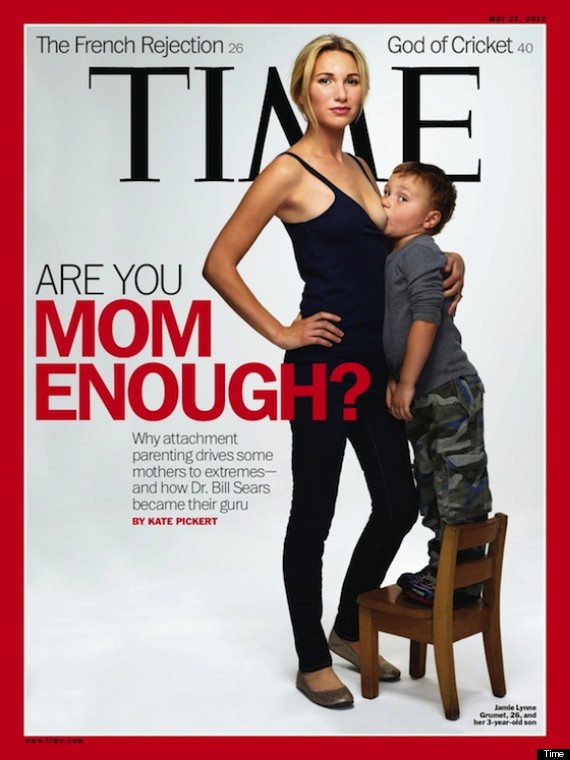
There have been a lot of annoying articles written about attachment parenting recently as part of the buzz created by TIME’s recent stunt.
But probably the most annoying article I’ve read is one published by the Guardian last Friday, written by Katha Pollitt. Her sub-heading claims that,

“The latest fashion in child-rearing is about regulating the behaviour of women, not benefiting children.”

That’s possibly the most twisted take on attachment parenting I’ve heard so far. Attachment parenting not about benefiting children? How did she arrive at that conclusion?

And clearly it is inconceivable that women could genuinely act out of love for their child, love of being a mother, and through natural instinct and informed choice. There must be some ulterior motive. Or they’re just fashion victims.

She accuses attachment parents of projecting their guilt ‘outward onto more relaxed mothers’. Strange. I’m not sure how I project something that I don’t feel, but if I make other mothers around me feel guilty then I’m very sorry, but I would gently suggest that the problem originates with their own perceptions and insecurities, none of which are within my control.

The article goes on to suggest that instead of practising attachment parenting our efforts would be better put into tackling child poverty, as this ‘affects children’s well-being more directly’ – a clear failure to grasp the whole concept of attachment parenting as a long term goal.

Sure, we need to tackle child poverty, but make no mistake, no matter how much we reduce poverty, social problems will not go away if we continue to fail to understand and take seriously the emotional needs of our children. And I’m not saying everyone must practise attachment parenting, but a little open-mindedness might help, a little more willingness to consider new ideas and information.

Ms Pollitt’s ignorant remarks are insulting, to say the least, and on more than one level. They are insulting to women who make this parenting choice, not just by dismissing the parenting style itself, but by suggesting that they are merely following a fad, are victims of some sort of social conspiracy to ‘regulate’ their behaviour, and furthermore, do not actually have the best interests of their children at heart.

As usual, the minority are an easy target for ridicule and attack. A typical social problem, and perhaps another example of our failure to raise human beings who are able to be respectful and empathetic towards each other.


Attachment parenting; not just for babies

May 18, 2012

Enough has been written about TIME magazine’s cover, and the service, or disservice it did to promoting attachment parenting. I feel anything I add would be mere minnows in an already raging sea of debate. 

But I will add this: What bugs me, aside from all the other issues with TIME magazine’s choice of cover, is that attachment parenting is, as seems all too common, made out to be all about breastfeeding. 

One thing I personally would like to shout out to parents who wish to know more about an attachment based parenting approach is that it is not just about breastfeeding, co-sleeping and baby wearing. 

OK, attachment theory informs us of how vitally important those first few years are.  How a child’s early life experiences can wire their brain, and form the basis of their social and emotional development, really cannot be over-estimated. So it’s essential that parents get this. But get this too; there’s still plenty of opportunity to screw things up after those first few years. 

It doesn’t matter how long we breastfeed or co-sleep for, or how secure our child’s attachment to us is, if we then go on to make poorly informed parenting choices as our children get older, this too has the capacity to do lasting harm. If a child is consistently subjected, day in, day out, for years, to parenting methods that harm self-esteem and parent/child relationships, and fail to meet their emotional needs, this too has far reaching effects. And even for the many children who emerge from it all OK, how much better could we have done? Better than just OK. 

Attachment parenting is for life, not just for babies. So let’s promote attachment parenting beyond infancy. I wonder what TIME magazine would come up with as a cover photo for this. Any ideas?


The Treasure Box

May 9, 2012

When I was a child I had a scrap-book. In it I kept various souvenirs and mementoes. I thought this would be a nice thing to do with my own child, so I bought a scrap-book, then felt guilty ever after for not having got round to putting anything in it, and since my child hasn’t shown much interest, it has fallen by the wayside.

Then, someone told me about the treasure box. Rather like a scrap-book, but without any pesky sticking, and able to contain items of a shape and size other than very thin and flat, the treasure box is a place you can keep, well, anything you like.

First pair of shoes.

Favourite cot toy from babyhood.

Once favourite book now grown out of and cast aside.

Tickets from first train, plane, bus or boat ride, or any rides you like.

Random photos that people have given us and I was never quite sure what to do with.

Selected congratulations cards from when child was born.

Mementoes of special family events; an invitation to Grandad’s 70th birthday party, the birth of a cousin, a wedding….

Selected things my child has made that he was particularly pleased with and likely to remember.

Entry tickets from days out.

A pebble or shell from a day out at the beach.

Achievements; badges and certificates.

Select photos of milestone events – first started to walk, first mastered scooter/bike, first sleepover at Granny’s, first camping trip…….Nowadays we tend to store all our photos electronically, so opportunities to look through photos together, whilst still perfectly possible, just don’t present themselves as readily, so it’s nice to print some select ones out, for the treasure box or for the walls.

If you move house or redecorate you could keep scraps of the old curtains, wallpaper or carpet. It might sound a bit odd but think about your early childhood memories. Think of the home where you grew up. Think of the sights, smells and sounds that you experienced and still remember. Can you remember the colour of the curtains in your bedroom or the pattern on the wallpaper? What could you see from your bedroom window? What sounds did you fall asleep to? What else can you remember that sticks in your mind?  All these things, subconsciously at first, make us feel secure and attached.

But the treasure box is not just about attachment and security. It’s about celebrating your child’s life, their unique identity, and helping them build a positive sense of self.  It helps develop a sense of passing time and focusses on the many positive aspects of your child’s experiences. Plus, getting the treasure box out and spending some special time together looking through it and talking about it can be a wonderful connecting experience, and a very positive experience for your child.

What’s more, it’s something a child will really value in years to come. Every adult I’ve talked to about the treasure box says how much they’d love to have something like that from their childhood.

So decorate an old box today. Together.


Connection is the key.

May 2, 2012

Connection is about maintaining that close, loving, attuned relationship in which a child will feel secure and loved, and will thrive. This alone gives us something to constantly strive for. But there are also practical day-to-day benefits. Connection is the key to preventing and reducing unwanted behaviours, and to gaining cooperation. If my child is disconnected, this is when unwanted behaviour is likely to occur. We need to reconnect. This is why punitive responses to behaviour don’t work. They only widen that feeling of disconnection.

But what does connection mean exactly?

Lawrence Cohen, as usual, does a great job of describing this concept in “Playful Parenting”. He starts by describing that deep connection between babies and their parent, sometimes referred to as eye-love (we all remember those long periods of eye contact with our babies) then goes on;

“If all goes well, the eye-love between infants and parents is replaced by a less blissful, but still solid, connection. You and your child are able to talk or play or hang out easily together, enjoying each other, relatively in tune. These moments can be quiet times, like just before falling asleep, or active playtimes. The next level is a more casual connection, an unspoken bond that may be noticed only when it’s gone, replaced by conflict or distance. At the extreme are the most alienated types of disconnection. Disconnection can be a nightmare of painful isolation, withdrawal, and lashing out…….even normal, healthy children have moments when they lose that thread of connection. They retreat into towers of isolation when they feel lonely, afraid, or overwhelmed.”

How do I know when my child’s disconnected? It’s hard to describe exactly as it’s sometimes a subtle change like avoidance of eye contact, feigned lack of interest in my offers of closeness, an extra jumper or a snack. But often it’s obvious; loud, out of control, slightly crazy behaviour, and at worst, lashing out, either physically, verbally, or just by doing things calculated to enrage.

The more I observe these behaviours, the more likely I am to be able to predict when they might happen, and so take steps to prevent it happening in the first place. So, often I’ll make a point of reconnecting before any difficult behaviour starts, like at school pick up time, or any other time we may have been separated, not just by school, but maybe because he’s just been busy playing outside with his friends all morning.

Sometimes we just need a ‘quick connect’, like a quick high-five, or a joke and a giggle together, or a special something that only the two of us know about. Anything that involves giggling and/or eye contact nearly always works.  Giving a quick passing hug or a kiss usually doesn’t – he needs to be engaged with it, accepting of it.

Sometimes we need to have a longer period of one to one time together, usually playing, especially rough and tumble play that involves lots of physical contact, but also imaginary play that will often bring out things that might be troubling him.

Sometimes, I’ll need to insist on reconnection – in other words, I don’t accept rejection. Children need to know we’re always there for them and that we love them no matter what. Whilst there might be times when they really do need to be alone for a while, and I actually find these are rare, shouts of ‘Go away’ are often a test to see if we really will go, or if we love them enough to stay even when they’re behaving horribly towards us.

Many little things throughout the day can cause that connection to be strained or broken – failing to empathise with something he got upset about, a few harsh words or a betrayal of annoyance and impatience, a disagreement about whether he’s allowed to do or have such and such. Having a handful of ways to reconnect and incorporating these into our day-to-day interactions can help stop things getting out of hand.

One connection technique I sometimes use with my child is challenging him to look constantly into my eyes while we both count to ten. It’s become a bit of a game, and usually gets a bit of a giggle, as well as some eye contact. I’ve always thought the success of it was somewhat varied until the other day. He did something that really annoyed me (I won’t bore you with the details of what it was, it was a silly thing really in hindsight) and I made my annoyance very clear. He said sorry, then put both arms round me and said “Mummy, we need to connect, let’s look into each other’s eyes.”

So we looked into each other’s eyes and counted to ten.

Priceless.


Unpunished

April 18, 2012

I don’t punish my child for his behaviour. I haven’t done for a few years now. Before I made this shift in my approach and attitude I would have thought these statements sounded extreme. But now I often find myself reflecting on how I actually never feel the need to punish. My child presents his fair share of challenging behaviour, yet strangely I never find myself wishing I could dish out a punishment, or having to remind myself not to. The less you punish, the less you need to punish. Punishment only makes behaviour worse.  I was commenting on this to my husband last night, then suddenly remembered that earlier that evening my child had hit out at me. Surely this would be considered by many to be punishable behaviour. Yet it never occurred to me at the time, and reflecting on it afterwards, I’m still quite certain that it was right not to punish.

My child had been at school all day. When he came home, after a snack, he said he wanted to play ‘rugby on the bed’ with me. This is his name for playing rough and tumble, and one of our main ways of reconnecting with each other. We had a lovely play and a giggle together for a few minutes, then he heard voices, looked out of the window and saw his friends from next door playing outside. He immediately announced that he wanted to go outside and play with them, but with a hint of regret at ending the time we were having together. I commented that we could always have another play later, and off he went.

There was never an opportunity to resume our rough and tumble play that evening for one reason or another. When I announced it was bath-time my child started bouncing on the bed – a clear and common indication of his intention to be uncooperative. Being accustomed to these tactics, and having various means of dealing with them, I was unphased until he started hitting out at me. His hits were more like swipes, reminiscent of the warning swipe a cat might give with her claws retracted. There was no intention to hurt, but there clearly was the  intention to communicate something.

“No hitting”.

He continued.

“No hitting” – this time gently taking hold of his hands. I knew there was something wrong, and I had a pretty good idea what it was.

When he was calm we talked.

“Are you sad that it’s bath-time?”

“Yeeeees”, came the sad cry.

“Do you feel like we haven’t had enough time to play together?”

“Yeeeees”.

“Tomorrow I’m picking you up from school early so we’ll have all afternoon”, then realising this was trying to fix things and not validating the feelings he was experiencing right now in that moment, “We were playing rugby on the bed then you went outside to play with your friends, and we never got a chance to play again”.  A cuddle.  “Let’s get ready for your bath really quick so we’ll have time for some extra books tonight”.

A minute later he was playing happily in the bath.

Did he ‘get away’ with hitting? Was a punishment required to ‘teach’ him that hitting is wrong?  I think not. He knows hitting is wrong. That’s why he was doing it. He was doing wrong because he was feeling wrong inside and couldn’t quite find the words to tell me about these feelings.  He may not even have been sure exactly what those feelings were or what gave rise to them. He may have felt angry at me when he realised the day was nearly over and we had not had enough one to one time together.

I reminded him “No hitting” and gently enforced that limit. I then helped him process the feelings that had given rise to the behaviour. That is all that was needed. If I had responded by putting him in a timeout, or saying ‘no books tonight’, giving him a ‘sad face’ sticker on a chart, or come up with some other parent imposed ‘consequence’ would this make him less likely to hit again? Absolutely not. If anything it would make his behaviour worse. He would feel bad about himself, angrier with me, and more disconnected from me (the very issue that caused the behaviour in the first place), and the opportunity for me to help him process those feelings would have been lost.

He lost control. He did wrong. He’s a kid and he’s not perfect. I’m not going to punish him for that. I will, however, be more mindful of incorporating one to one time into our days. My child is not the only one with lessons to learn here.

Punishment does not teach. Empathy, understanding, and love teaches volumes and equips children emotionally to deal with their feelings and problems in a more mature way.


Perceptions of pressure and blame.

April 4, 2012

One of the greatest challenges when writing about parenting is trying not to upset people.  Parenting seems to be a very touchy subject, an area where people will become fiercely defensive, easily offended.

In a recent article in the Guardian about the government’s proposals to provide free parenting classes for parents of under fives, a founder of one of the courses was reported to have said that “challenging someone’s parenting skills is one of the strongest challenges to their identity”. The article also talks about parents’ reluctance to sign up for courses due to a perception that they are being accused of being bad parents. “Providers have to avoid any suggestion that the courses are created to help bad parents; instead they need to persuade people it’s about “building on their good points”.”

Another article describes how parenting books “leave mothers feeling confused and inadequate.” Parenting authors are accused of “setting the bar too high”.

This perception, that too much is expected of parents, that parents are being accused of having poor parenting skills, was again apparent when I was reading, with some surprise, the comments made on Facebook in response to an article challenging the use of sticker charts, published as a guest post on the excellent Positive Parenting: Toddlers and Beyond, and also shared by other bloggers who I follow, who in turn attracted some interesting comments.

I ‘m starting to see a bit of a theme here, but there’s something about it that bothers me. It somehow doesn’t ring quite true for me.  It seems (and here I’m going to risk upsetting people), to be a bit of a cop out.  It seems dismissive, a failure to take things on board.

“There are much worse things parents could do”, “Oh please, I’m doing my best”, “It’s unreasonable to expect parents to get everything right”, “There’s so much pressure on parents these days”, “It’s not fair to make parents feel guilty.” etc etc

All perfectly true, I’m sure, but is this an argument for using sticker charts, for example? I would have felt much better if readers had responded with comments as to why they think rewards are OK, pointed out evidence that disputes the research behind the case against rewards, or even, and here’s possibly the crux of it, simply said that they realised rewards were not OK, but that they still choose to use them for whatever reason. Fair enough.  Your choice. Just don’t play the ‘don’t make me feel guilty’ card.

I mean, really, where does it stop? At what point is a piece of writing acceptable and useful, and at what point is it “putting too much pressure on parents”? Where do we draw the line?

Articles and books about the negative effects of punishments, about the campaign against spanking, the campaign against the use of controlled crying, pressure groups seeking better childcare for under 3s, campaigns to promote breastfeeding – are these all to be dismissed as simply putting unreasonable amounts of pressure on parents and making them feel guilty?  It seems to me we can conveniently produce the “Don’t put pressure on me and make me feel guilty” defence whenever we find something too challenging.

But there’s another element here for me. We must all be mindful of accepting other people’s parenting choices, yet it sometimes seems to me that this acceptance is not always a two way thing. I once heard a parent comment about another parent’s use of a sling to carry her baby. “I always put my children in a pram and they’re not any less attached to me”. (How do you know? Have you done a comparison study?) But can you imagine the outcry if a sling-using parent made such a dismissive and disrespectful comment about a parent who chose a pram? There’s something kind of unfair to me here. Parents who choose to do things perceived to be ‘the hard way’ don’t seem to be getting their fair share of respect.

Parenting writers provide information and opinions, food for thought. Good ones provide evidence to back up their arguments, or have studied their subject extensively. But they don’t set out to call anyone a bad parent, anymore than mothers who use slings are calling  mothers with prams bad parents. Let’s not dismiss what writers and others have to offer. Let’s  make informed choices and be honest about our reasons for making them.

And so it is with the example of Kelly Bartlett’s article on sticker charts.  The information is there. It’s evidence based stuff. And yes, it challenges a popular parenting assumption, and probably makes life more difficult in the short term.  But if we’re really interested in being better parents, we need to take information such as this seriously, look further into it (there’s plenty more been written on the subject), think about, and not just dismiss it with the defensive “I’m doing my best, there’s too much pressure” stance. And OK, if we still feel unable or unwilling to change this aspect of our parenting that is our choice.

I’ll finish with a quote from Alfie Kohn. He writes in his book, “Unconditional Parenting”, about the different reactions he often gets from parents when he talks about the negative effects of too much praise.

“Some people…..brush off these criticisms, point out (with some justification) that in the larger scheme of things, we could do a lot worse to our kids than express enthusiasm about what they’ve done. Indeed, a lot worse is done to children every day. But that’s not a proper basis for comparison – at least, not for anyone who wants to be the best parent he or she can be. The point is that we can do better.”